

Why Cheap Swimwear Manufacturers Cost You More Later
- kahin16
- Jul 10
- 7 min read
If you've ever grabbed a $20 swimsuit and watched it fade, stretch out, or fall apart after two wears, you already know this feeling. The upfront savings disappear fast — and you're back shopping again before summer even ends.
This guide is for swimwear brand owners, buyers, and conscious shoppers who want to stop burning money on fast fashion swimwear problems and start making smarter, longer-term decisions.

Here's what we'll break down: why swimwear fabric quality directly affects how long your suit lasts, how ethical swimwear manufacturing drives up production costs for all the right reasons, and why sustainable swimwear certifications that seem expensive now actually save you money over time.
Cheap swimwear manufacturers cut corners somewhere — and you're usually the one who pays for it.
The Hidden Costs of Cheap Swimwear Fabric
Why Low-Quality Materials Fail Faster in Harsh Conditions
When you choose swimwear made from cheap, low-grade fabric, you are essentially setting yourself up for a cycle of repeated purchases. Swimsuit fabric must endure some of the harshest conditions any textile faces — prolonged exposure to chlorine in pools, salt in ocean water, and intense UV radiation from the sun. Low-quality materials are not engineered to handle this triple threat.

Here is what typically happens when you opt for inferior swimwear fabric:
Chlorine degradation: Cheap synthetic blends break down rapidly when exposed to chlorinated pool water, causing fibers to weaken, stretch out permanently, and lose their shape after just a handful of uses.
UV damage: Without UV 50+ protection built into the fabric itself, low-quality swimwear fades, becomes brittle, and offers little to no sun protection over time.
Salt and mineral wear: Saltwater accelerates fabric deterioration in budget materials, leading to thinning, pilling, and a rough, uncomfortable texture against your skin.
Loss of stretch: Quality swimsuit fabric requires a true 4-way stretch capability. Cheap alternatives lose their elasticity quickly, meaning your swimwear sags, bags, or distorts after minimal wear.
The result? You end up replacing your swimwear far more frequently than you should. What seemed like a budget-friendly choice at checkout quickly becomes one of the more expensive decisions you make over a single swim season. This is one of the core hidden costs of cheap swimwear that many buyers do not anticipate until it is too late.
How Premium Fabrics Like Recycled Nylon Save Money Per Wear Over Time
With this in mind, it is worth shifting your perspective from the upfront price tag to the cost per wear — a much more accurate way to evaluate the true value of your swimwear investment.
Premium swimsuit fabrics, including high-quality recycled nylon blends, are specifically engineered to maintain their performance properties across extended use. When your swimwear fabric delivers:
UV 50+ protection that does not wash out after a few sessions
4-way stretch that retains its original shape and compression
A smooth, cool hand feel that stays consistent even after repeated chlorine and saltwater exposure
...you are getting a garment that simply lasts longer and performs better every single time you wear it.
Consider this straightforward comparison:
Factor | Cheap Swimwear Fabric | Premium Swimwear Fabric |
Average usable lifespan | 1–2 seasons | 3–5+ seasons |
UV protection longevity | Fades quickly | UV 50+ retained over time |
Shape retention | Loses elasticity fast | 4-way stretch maintained |
Feel against skin | Rough and irritating after wear | Smooth and cool consistently |
Cost per wear | Higher due to frequent replacement | Lower over extended lifespan |
When you do this math, premium swimwear fabric is not an extravagance — it is a financially sound decision. The swimwear fabric quality you invest in upfront directly determines how much you spend over time. Choosing quality over cheapness is how you genuinely save money in the long run.
The True Cost of Sourcing High-Performance, Quick-Drying and Chemical-Resistant Yarn
Now that we have covered how premium fabrics save you money per wear, it is equally important to understand why high-quality swimwear fabric commands a higher price at the source — and why that price is entirely justified.
Sourcing yarn that delivers the full spectrum of performance features required for professional-grade swimwear is a complex and costly undertaking. The yarn used in truly high-quality swimsuit fabrics must be:
Quick-drying: Engineered at a fiber level to wick and release moisture rapidly, keeping you comfortable in and out of the water.
Chemical-resistant: Capable of withstanding repeated exposure to chlorine, saltwater, sunscreen, and other chemicals without breaking down structurally or aesthetically.
UV-protective: Woven or knitted to a density and composition that naturally blocks harmful UV rays, providing UV 50+ protection without relying on chemical treatments that wash away.
Stretchable with recovery: Able to stretch fully in four directions and snap back to its original form, maintaining both fit and function after every use.
Sourcing yarn with all of these properties simultaneously is not something that happens cheaply or easily. The fiber selection, dyeing processes, and manufacturing standards required to produce fabric that performs at this level represent a significant investment that cheap swimwear manufacturers simply do not make.
When brands or manufacturers cut costs on yarn sourcing, every single one of these performance characteristics suffers. Your swimwear loses its quick-dry capability faster. It degrades under chemical exposure. The UV protection diminishes. The stretch becomes unreliable.
Understanding the true cost behind sourcing high-performance yarn reframes your entire view of affordable vs. quality swimwear. The price difference you see at retail is not arbitrary — it is a direct reflection of the material investment made long before your swimwear ever reaches your hands. The brands and manufacturers that refuse to compromise on yarn quality are the ones delivering swimwear that genuinely earns its place in your wardrobe season after season.
Ethical Labor and Manufacturing Drive Up Prices for Good Reason
How Fast Fashion Keeps Prices Low by Exploiting Workers
When you purchase swimwear from cheap swimwear manufacturers, the low price tag often comes at a devastating human cost. Fast fashion brands keep their prices artificially low by relying on workers in developing countries who face unfair wages, unsafe working conditions, and excessive overtime hours — costs that never appear on your receipt but are paid by someone else entirely.

Why Paying Fair Wages and Ensuring Safe Conditions Costs More Upfront
When ethical swimwear manufacturing is a priority, brands must partner with factories that uphold fair labor standards, ensure worker safety, and provide opportunities for advancement. These commitments require meaningful financial investment. Your higher upfront cost directly funds dignified working conditions rather than subsidizing exploitation hidden deep within a complex supply chain.
The Real Price of Ethical Production Compared to Overseas Cheap Labor
Factor | Cheap Overseas Labor | Ethical Manufacturing |
Worker wages | Below living wage | Fair, livable wages |
Working conditions | Often unsafe | Regulated and safe |
Supply chain transparency | Minimal | Clear and accountable |
Long-term brand trust | Low | High |
With this in mind, when you choose ethical swimwear manufacturing over fast fashion swimwear, you are not overpaying — you are paying the true cost of production that cheap swimwear manufacturers deliberately obscure.
Superior Construction and Design Details Justify Higher Price Tags
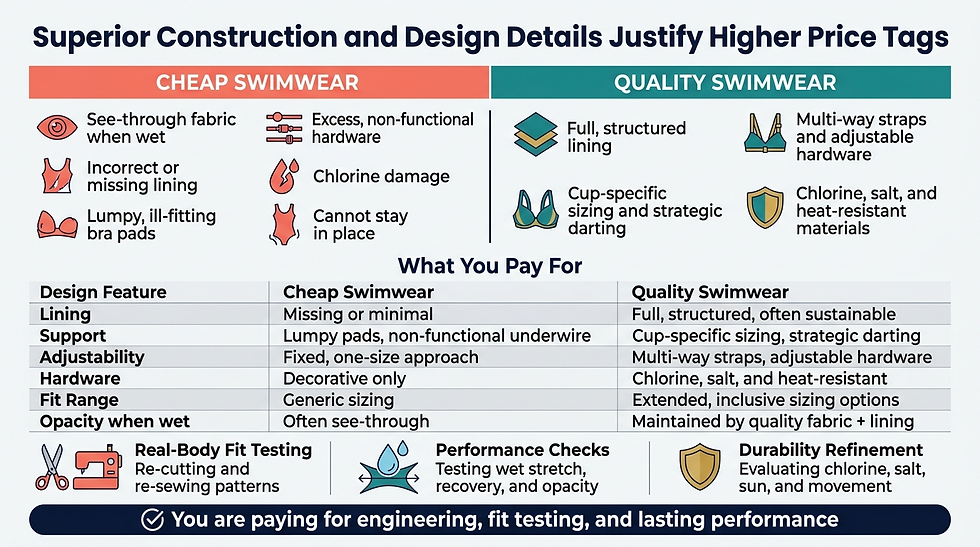
Common Flaws Found in Cheaply Made Swimwear
When you buy from cheap swimwear manufacturers, the construction flaws become obvious fast. Unlined or poorly lined suits turn transparent when wet, seams pop under stretch, and fabrics sag after just a few wears because low-recovery materials simply can't snap back into shape, leaving you with a swimsuit that looks worn out long before its time.
How Thoughtful Design Elements Like Lining, Support and Adjustability Add Value
Quality construction means your swimsuit includes purpose-built linings that provide coverage, structure, and comfort all at once. A properly chosen nylon-spandex tricot lining prevents sheerness, reduces chafing, and extends the garment's lifespan by absorbing friction and chlorine exposure before the outer fabric does. Beyond basic lining, reputable manufacturers incorporate power mesh panels for tummy control, molded cups for bust support, and reinforced seams that hold their shape through repeated wear. These design decisions cost more to execute, but they deliver a swimsuit that actually fits and functions the way you need it to — without constant adjusting, pulling, or worrying about coverage.
Why Testing on Real Bodies and Refining Samples Increases Production Costs
With this in mind, it's worth understanding why quality swimwear carries a higher price tag at the production stage. Getting lining placement, stretch percentages, and support structures right requires testing on real bodies and refining samples multiple times. Mismatched stretch between outer fabric and lining, for example, causes distortion, discomfort, and premature failure — problems that only surface during wear trials. Your investment in a well-constructed swimsuit reflects all the refinement work done before it ever reached the shelf.
The Complex Manufacturing Process Behind Every Quality Swimsuit

How Fabric Sourcing, Sampling, and Specialized Labor Drive Up Costs
When you choose quality over cheap swimwear manufacturers, you're paying for a layered swimwear manufacturing process that begins long before a single stitch is made. Fabric sourcing, tech pack creation ($50–$500 per design), and multiple sampling rounds ($50–$300 per sample) all accumulate into significant upfront investment that protects your long-term value.
Why Wholesale Markups Make Retail Prices Multiply Significantly
Once your cut-and-sew production costs ($15–$50 per unit) are factored in alongside quality control, labor, and packaging, every layer of the wholesale supply chain adds its own markup. What you see as a higher retail price tag directly reflects these compounding costs — costs that cheap swimwear manufacturers quietly skip, leaving you to pay later through poor durability and returns.
How Selling Direct-to-Consumer Can Reduce But Not Eliminate Price Gaps
Selling direct-to-consumer can help your brand reduce some markup layers, but it doesn't eliminate core costs like premium fabric, specialized labor, e-commerce platform fees ($30–$300/month), and sustainability initiatives. With this in mind, understanding the full swimwear manufacturing process helps you see why affordable vs. quality swimwear isn't simply a price difference — it's a value difference that shows up every time a customer wears your product.
The true cost of a swimsuit goes far beyond its price tag. From the quality of the fabric and the fairness of the wages paid to the people who made it, to the construction details that actually hold up over time and the sustainability certifications that protect both people and the planet — every dollar in a well-made swimsuit is there for a reason. When you choose cheap, you're not just risking a suit that falls apart after one summer. You're also supporting a system that cuts corners on labor, materials, and environmental responsibility.
The next time you're tempted to grab a $20 swimsuit, ask yourself what you're really paying for — and what others might be paying on your behalf. Investing in quality swimwear means fewer replacements, better fit, and a cleaner conscience. It's a choice that pays you back in more ways than one.


Comments