

How to Create Tech Packs for Fashion Startups Easily
- Hin

- Mar 10
- 6 min read
Startups who skip tech packs average 4.5 sampling rounds before production. Those with proper documentation? Just 1.8 rounds. At $150-$350 per sample, that's $270-$630 in savings per design.
But if you're new to fashion, "tech pack" probably sounds intimidating. Creating one doesn't require expensive software or a design degree. This guide breaks down how to create professional tech packs on a startup budget, even if you've never worked in fashion before.
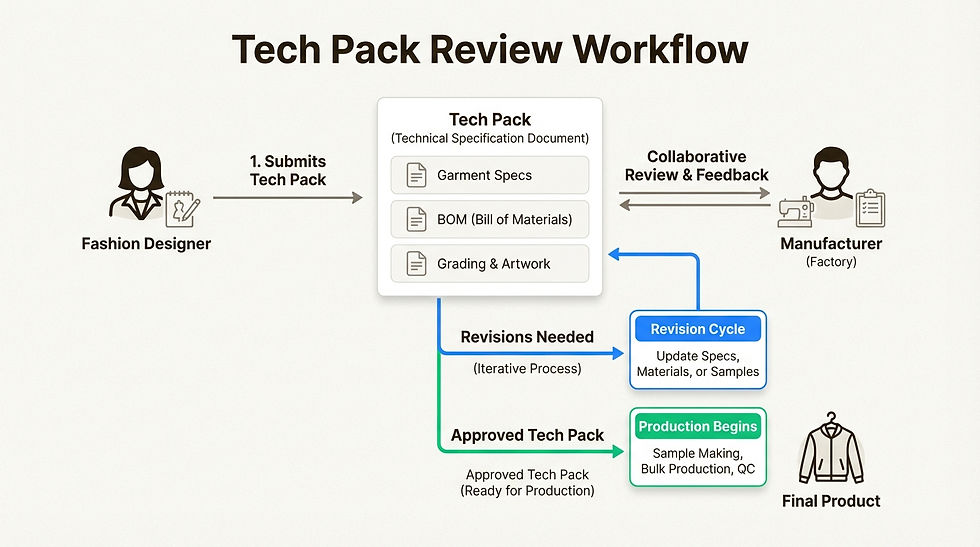
The 5 essential components every tech pack needs
Every professional tech pack contains the same core elements. Master these five components and manufacturers will have everything they need to quote accurately and produce your designs correctly.
Flat sketches (front and back views)
These are technical drawings, not artistic sketches. They show your garment in black and white from the front and back, with every seam, stitch, button, and dart clearly visible. Flat sketches prioritize clarity over style.
You can create these in Adobe Illustrator, but free alternatives like Inkscape or Gravit Designer work well for beginners. The key is precision: if a factory can't see exactly where a pocket sits or how a collar is constructed, they'll make assumptions that might not match your vision.
Bill of materials (BOM)
Your BOM is a complete inventory of everything that goes into your garment: main fabric (composition, weight, source), lining or secondary fabrics, thread colors and types, all trims (buttons, zippers, labels, elastic), and packaging materials.
If you know your suppliers, include their details. If not, be as specific as possible about compositions and weights. "Blue cotton" isn't enough. "180gsm 100% organic cotton jersey in Pantone 19-4052" gives factories what they need to source accurately.
Measurements and size chart
This section lists every point of measure (POM) for each size you plan to produce. Include grading rules (the difference between sizes, usually 2-4cm per size), tolerance levels (acceptable variation noted as TOL+ and TOL-), and measurement definitions (where exactly each measurement starts and ends).
Without tolerances, factories have no guidance on what's acceptable. A 1cm variance might be fine for a budget t-shirt but unacceptable for performance activewear.
Color specifications
Always use Pantone codes for color accuracy. For textiles, use Pantone TCX (Textile Cotton eXtended). Include every colorway variation you're producing. If your design comes in black, navy, and heather grey, document all three with their specific codes.

Construction details
This section explains how your garment is assembled. Specify stitch types, seam finishes, and any special techniques like garment washing, screen printing, or embroidery.
Reference images help for complex details. A photo of the stitch type you want, or the exact placement of a logo, removes ambiguity that written descriptions might leave.
Step-by-step: creating your first tech pack
You don't need to complete this in one sitting. Many founders build their tech pack over several days as they research materials and refine measurements.
Step 1 | Header information | Begin with product name or code, collection or season, version number, and date. Include your brand contact information. |
Step 2 | Flat sketches | Draw front and back views of your garment using black lines on a white background. Add detail views for complex elements. If you can't draw, hire a freelance technical illustrator for this step alone. It costs far less than full tech pack services. |
Step 3 | BOM spreadsheet | Start with your main fabric and work through every component. Be specific about quantities: how many buttons, meters of elastic, labels. Include packaging if your manufacturer handles that too. |
Step 4 | Size chart | Pick a base size first (usually medium or size 10). Build other sizes using grading rules. Set realistic tolerances based on your price point. Budget garments have wider tolerances. Premium products demand tighter quality control. |
Step 5 | Colors and construction | Add Pantone codes and write clear construction notes. Include reference images for anything complex. |
Step 6 | Review and version control | Double-check measurements, verify Pantone codes, confirm BOM quantities. |
DIY vs. professional: making the right choice
You have three options for creating tech packs, each suited to different business stages.
Approach | Cost | Time | Best For |
DIY | Free | 2-4 hours | Startups, simple designs |
Freelance | $300-1,000 | 1-2 weeks | Complex designs |
Software | $50-200/month | 1-2 hours | Scaling brands |
DIY works when testing the waters. The risk is that mistakes lead to costly sampling rounds. But for straightforward designs and small batches, the learning curve can be worth it.
Professional services bring experience you don't have yet. The ROI is compelling: spend £200 on a professional pack that saves £500 in sampling costs. For complex garments or larger orders, this pays for itself immediately.
Software like Techpacker or Lifecycle PLM becomes worthwhile when managing dozens of styles across multiple seasons. The collaboration features and version control save time at scale.
For more on managing production costs, see our guide to low MOQ activewear manufacturing.
Working with manufacturers: practical tips
Provide complete information upfront. Factories need this to quote accurately. Incomplete tech packs lead to assumptions, and assumptions lead to samples that don't match your vision.
Use visual references for anything complex. Clear images beat perfect English, especially for overseas manufacturing. A photo of the exact stitch type or button style removes ambiguity.
Build 2-3 sampling rounds into your timeline. The first sample rarely comes back perfect. Plan for revisions and use your tech pack to track what needs changing.
Understand that cheaper price points mean larger tolerances. If you're producing budget-friendly basics, expect more variation. Premium ranges demand tighter quality control.
Your tech pack serves as your quality control reference. When production arrives, compare actual measurements to your spec sheet. Check materials against your BOM. Document any deviations for corrections.
For a complete framework on ensuring quality, read our activewear quality control guide for 2026.
Common mistakes of tech packs for fashion startups make
Learning from others' errors saves time and money. Here are the most frequent tech pack mistakes we see.
Skipping the tech pack entirely. This results in an average of 4.5 sampling rounds instead of 1.8. The cost difference is substantial.
Incomplete measurements. Missing tolerances or grading rules forces factories to guess. Their guesses rarely match your expectations.
Vague material specifications. "Soft cotton" isn't a specification. Fabric weight, composition, and source matter enormously for the final product.
Poor quality sketches. Artistic drawings that don't show construction details leave too much to interpretation. Technical flats are essential.
Not researching MOQ requirements. Designing elaborate garments without checking if factories will produce them at your desired quantity wastes everyone's time.
Start creating your tech pack today
Tech packs are non-negotiable in fashion manufacturing, but they don't have to be complicated or expensive. Start with the five essential components, use the tools you already have, and build your process as your brand grows.
The investment in a proper tech pack pays for itself through fewer sampling rounds and better production outcomes. For a startup watching every penny, that's significant.
Ready to manufacture? New High Limited offers free first samples and tech pack guidance for startups. We specialize in low MOQ activewear and swimwear production, helping emerging brands navigate manufacturing without massive minimum orders. Learn more about our OEM services and how we support small brands from design to delivery.
Frequently Asked Questions
How long does it take to create a tech pack for a fashion startup?
For beginners using DIY methods, expect to spend 2-4 hours per design. Professional services typically deliver within 1-2 weeks. Dedicated software can reduce this to 1-2 hours once you're familiar with the platform.
Can I create tech packs for my fashion startup without knowing how to use Adobe Illustrator?
Yes. Free alternatives like Inkscape or Gravit Designer work well for flat sketches. You can also hire freelance technical illustrators for just the sketching portion, which costs significantly less than full tech pack services.
What is the most important component of a tech pack for fashion startups?
The measurements and size chart. Without accurate measurements, grading rules, and tolerance levels, factories cannot produce consistent sizing across your range. This is where most startup tech packs fall short.
How much money can a proper tech pack save my fashion startup?
Research shows that proper tech packs reduce sampling rounds from an average of 4.5 to 1.8. At £100-£250 per sample, that's £300-£750 saved per design. Even accounting for the cost of creating the tech pack, the net savings are substantial.
Do all manufacturers require tech packs for fashion startups?
Most professional manufacturers won't work with you without a tech pack. It protects both parties from misinterpretation and serves as a legal document of specifications. Some small-batch or sample makers might work from sketches, but production factories require proper documentation.
What software should fashion startups use to create tech packs easily?
Start with Excel for your BOM and measurements, paired with free design tools like Inkscape for sketches. As you scale, consider dedicated platforms like Techpacker or Lifecycle PLM. These offer templates and collaboration features that justify their subscription costs when managing multiple styles.
How detailed do tech packs need to be for small batch production at fashion startups?
Even for small batches, include all five essential components: flat sketches, BOM, measurements, color specifications, and construction details. The complexity can match your garment's simplicity, but skipping sections entirely invites errors that are costly regardless of order size.


Comments